Note
Access to this page requires authorization. You can try signing in or changing directories.
Access to this page requires authorization. You can try changing directories.
This article shows you how to add Fabric job event source to an eventstream.
Job events allow you to subscribe to changes produced when Fabric runs a job. For example, you can react to changes when refreshing a semantic model, running a scheduled pipeline, or running a notebook. Each of these activities can generate a corresponding job, which in turn generates a set of corresponding job events.
With Fabric event streams, you can capture these Job events, transform them, and route them to various destinations in Fabric for further analysis. This seamless integration of Job events within Fabric event streams gives you greater flexibility for monitoring and analyzing activities in your Job.
Event types
| Event type name | Description |
|---|---|
| Microsoft.Fabric.ItemJobCreated | Raised when the Fabric platform creates or triggers a job, manually or scheduled. |
| Microsoft.Fabric.ItemJobStatusChanged | Raised when the job status changes to another nonterminal state. This event isn't raised if the workload doesn't push when the status changes. The job status might change from created to completed soon. |
| Microsoft.Fabric.ItemJobSucceeded | Raised when the job completes. |
| Microsoft.Fabric.ItemJobFailed | Raised when the job fails, including job getting stuck or canceled. |
Prerequisites
- Get access to a workspace in the Fabric capacity license mode (or) the Trial license mode with Contributor or higher permissions.
Add Fabric Job events as source
If you haven't added any source to your eventstream yet, select the Connect data sources tile. You can also select Add source > Connect data sources on the ribbon.
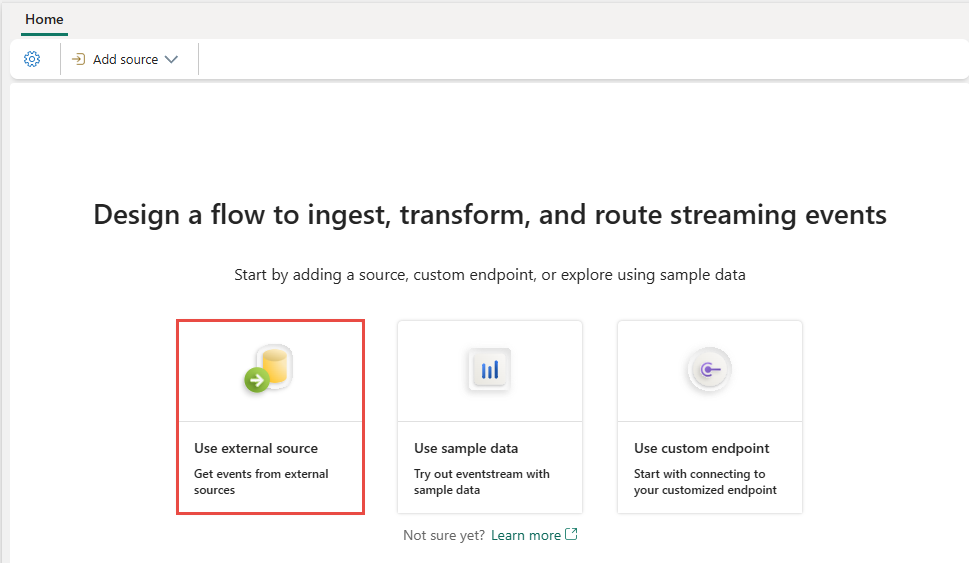
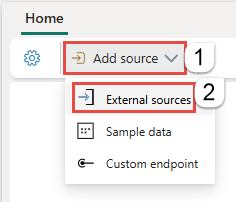
If you're adding the source to an already published eventstream, switch to Edit mode. On the ribbon, select Add source > Connect data sources.
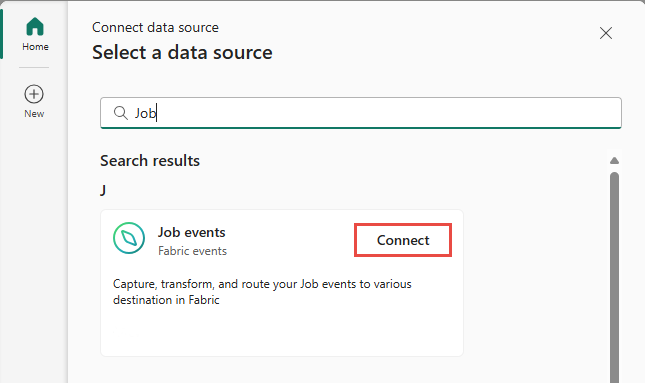
On the Select a data source page, search for and select Connect on the Job events tile.
Configure and connect to Fabric job events
On the Connect page, for Event types, select the event types that you want to monitor.

This step is optional. To see the schemas for event types, select View selected event type schemas. If you select it, browse through schemas for the events, and then navigate back to previous page by selecting the backward arrow button at the top.
For Event source, confirm that By item is selected.
For Workspace, select a workspace where the Fabric item is.
For Item, select the Fabric item.
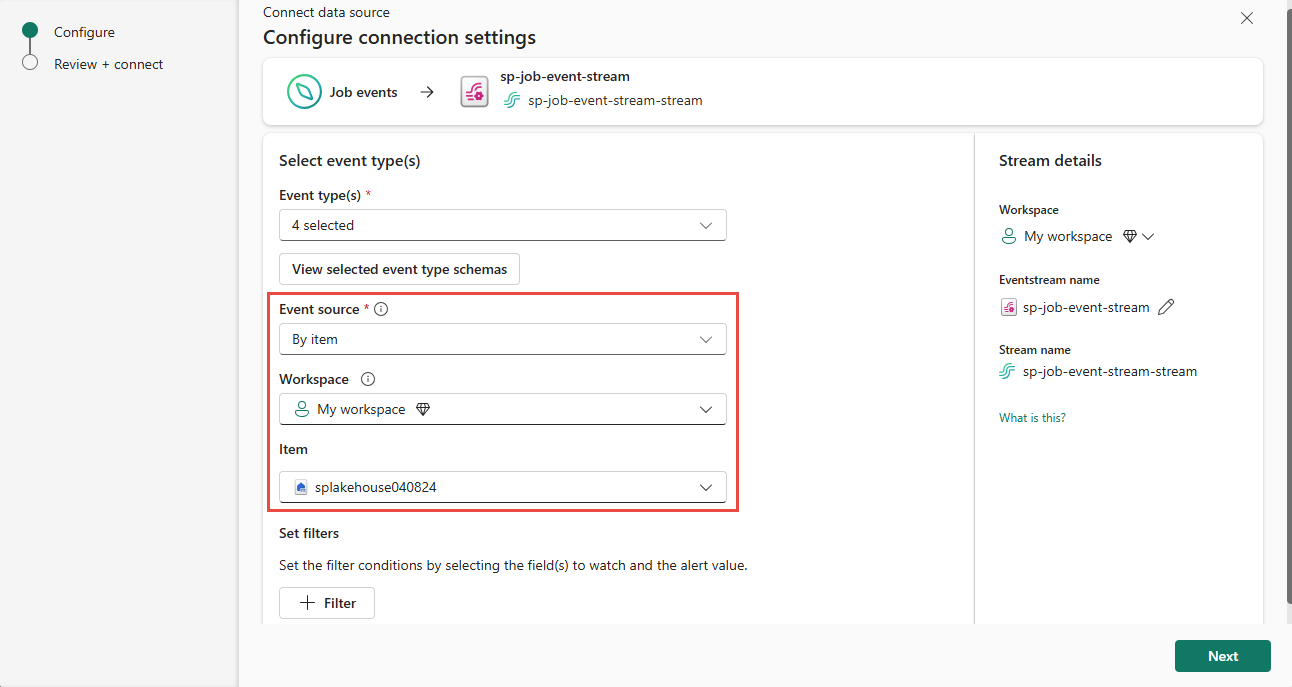
Now, on the Configure connection settings page, you can add filters to set the filter conditions by selecting fields to watch and the alert value. To add a filter:
Select + Filter.
Select a field.
Select an operator.
Select one or more values to match.


Stream or source details
On the Connect page, follow one of these steps based on whether you're using Eventstream or Real-Time hub.
Eventstream:
In the Source details pane to the right, follow these steps:
For Source name, select the Pencil button to change the name.
Notice that Eventstream name and Stream name are read-only.
Real-Time hub:
In the Stream details section to the right, follow these steps:
Select the Fabric workspace where you want to create the eventstream.
For Eventstream name, select the Pencil button, and enter a name for the eventstream.
The Stream name value is automatically generated for you by appending -stream to the name of the eventstream. This stream appears on the real-time hub's All data streams page when the wizard finishes.
Select Next at the bottom of the Configure page.
Review and connect
On the Review + connect screen, review the summary, and select Add (Eventstream) or Connect (Real-Time hub).
View updated eventstream
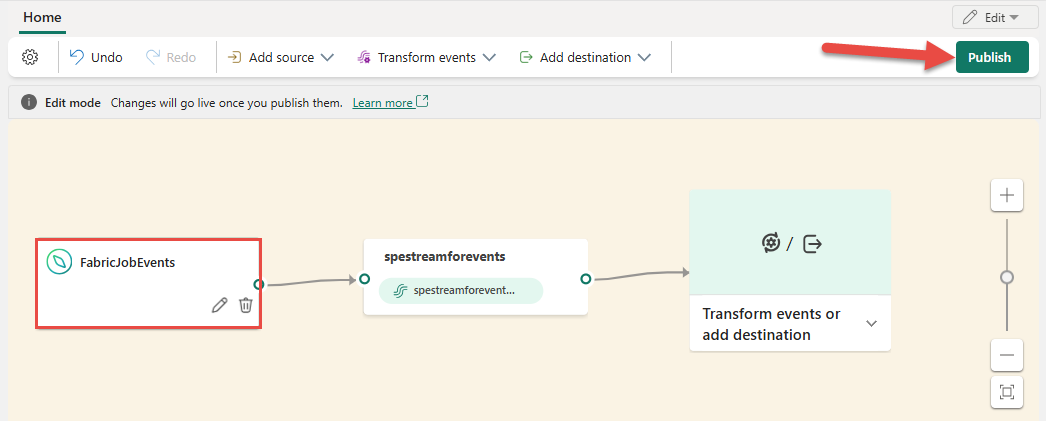
Once the connection is created, you can see the Fabric job events source added to your eventstream in Edit mode. Select Publish to publish the eventstream and capture the job events.
Note
Before proceeding with event transformation or routing, ensure that job events are triggered and successfully sent to the eventstream.
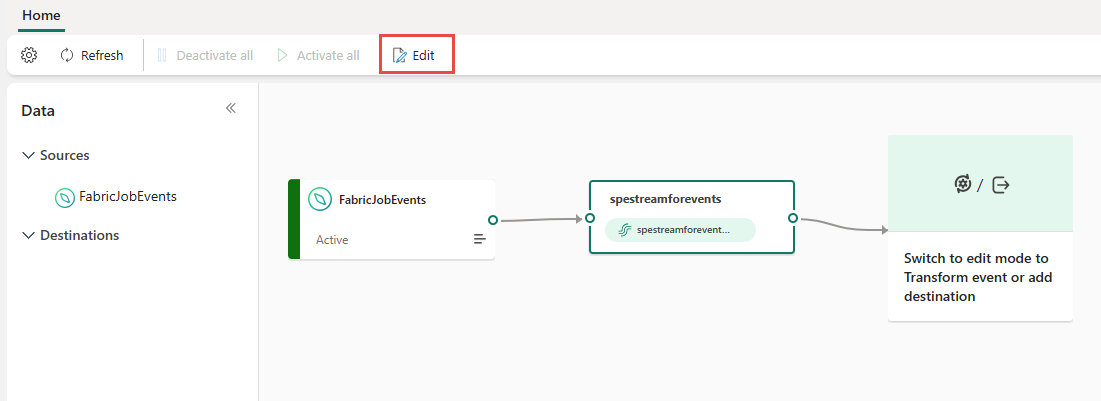
If you want to transform the Fabric job events, open your eventstream and select Edit to enter Edit mode. Then you can add operations to transform the Fabric job events or route them to a destination such as Lakehouse.
Known limitations
- Currently, error messages aren't available when an error occurs on discrete events sources.
- Currently, the Data Preview feature isn't available for discrete events sources.